Turn your business into a game you can win.
The full spec and prompt to build a Business Command Center: a visual map of your company that shows what's on fire, where growth is blocked, and what to fix next. Grab it and build your own with AI.
See what you'll build
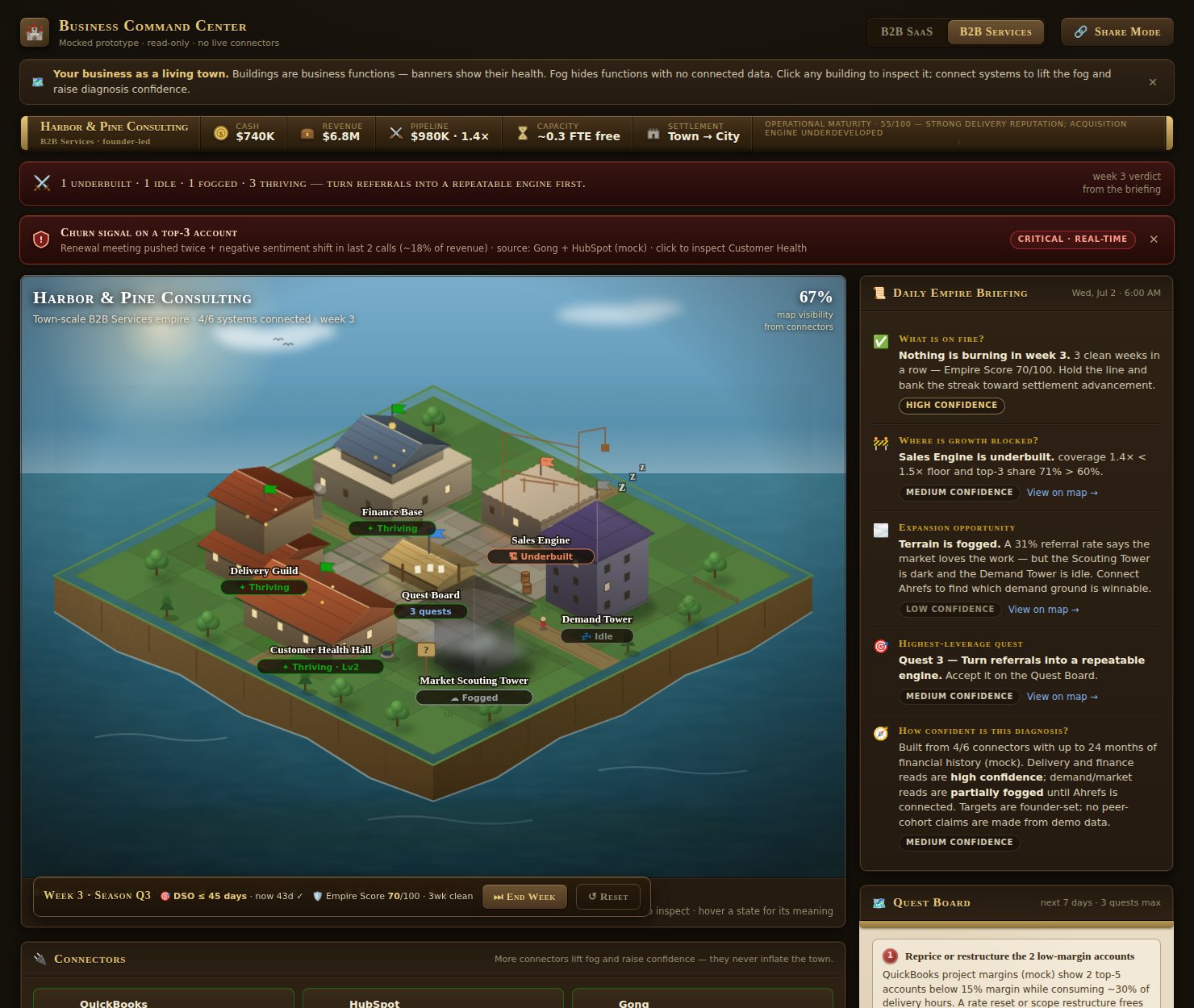
A peek at the mocked prototype: your business rendered as a living town, with health, fires, and the week's quests readable at a glance.
What you're getting
What you'll build
A starter city
From Outpost to Empire, generated from your business model and operational maturity, not vanity metrics.
Living buildings
Finance, sales, demand, product or delivery, customer health, market scouting, each thriving, constrained, idle, burning, or fogged.
A daily briefing
What's on fire, where growth is blocked, the one quest to run this week, each with a confidence label.
Share mode
A redacted map you can post without exposing revenue, customers, or deal names.
1. The prompt
The fastest start. Paste this into your AI coding agent and it builds the mocked prototype, one polished screen, read-only, no live systems.
Build a demo prototype for a Business Command Center Game.

Use mocked data only. The product is for founder-led B2B SaaS and B2B services
companies doing $1M-$20M in revenue.

The prototype should show:
- archetype selector for B2B SaaS vs B2B Services
- starter city generated from operational maturity, revenue stage, and connector visibility
- buildings for finance, sales, demand, product or delivery, customer health, and market scouting
- building states: thriving, constrained, idle, underbuilt, burning, fogged
- daily empire briefing
- quest board with 3 prioritized actions
- connector panel for Stripe/QuickBooks, HubSpot, Mixpanel, Gong, GA4/Search Console, and Ahrefs
- conservative confidence labels on diagnoses
- share mode that redacts raw numbers and produces a founder-shareable snapshot

Keep the first pass read-only and mocked. Do not implement live OAuth, production
writes, CRM mutations, sends, deploys, payments, marketplace actions, or external
API calls.

Prefer a single high-quality screen over a sprawling unfinished app. If there is no
app scaffold yet, create the minimum app needed for a local browser demo, start a
local dev server, and report the URL.
2. The full build packet
The whole spec: thesis, locked decisions, buildings, briefing logic, starter-city rules, share mode, monetization path, constraints, and acceptance criteria. Copy it in alongside the prompt.
# Business Command Center Game — Build Packet

A ready-to-build spec for a private, permissioned **business command center game** for founder-led B2B SaaS and B2B services companies doing roughly $1M–$20M in revenue.

It turns real business data into a visual, shareable operating map: where growth is blocked, what's on fire, where you can expand, and what to add next. Starts as a free map, can grow into a paid command center plus a marketplace for help.

**How to use this packet:** paste the prompt at the bottom into your AI coding agent (Claude Code, Codex, or similar) along with this spec. Build the mocked prototype first. Do not connect live systems until the map, game loop, and trust model are clear.

---

## Core thesis

The game is the interface. The command center is the value.

Connect a few systems and immediately see:

- A starter base or city based on your business model and operational maturity.
- Buildings for finance, sales, marketing, product or delivery, customer health, and market scouting.
- Fires, bottlenecks, idle buildings, missing infrastructure, and expansion opportunities.
- A daily briefing and a small number of quests for the next 7 days.
- A shareable redacted version of the map that creates social pull without exposing sensitive data.

The first "wow" is not a dashboard. It is a visual map plus one brutally specific growth-bottleneck diagnosis.

## Locked product decisions

1. **ICP:** founder-led B2B SaaS and B2B services, roughly $1M–$20M revenue.
2. **Mode:** a command center game, closer to Age of Empires or Clash of Clans than a combat RTS.
3. **MVP posture:** read-only connectors only. No writes, sends, deploys, CRM mutations, billing actions, or external actions.
4. **Cadence:** daily briefing by default; real-time alerts only for existential or fast-decay events.
5. **Archetypes:** two thin archetypes from day one, B2B SaaS and B2B Services.
6. **Starter city scoring:** business model and operational maturity first, revenue second; connector count only controls visibility and confidence.
7. **Connectors unlock visibility:** more connectors remove fog of war and improve confidence. They do not create vanity status by themselves.
8. **Benchmarking:** conservative and confidence-labeled. Do not overclaim early network benchmarks.
9. **Monetization path:** free map first, paid command center second, managed growth and operator marketplace third.
10. **Trust principle:** private by default, anonymized aggregate intelligence only, redacted share mode.

## First version (mocked data)

Build a demo-quality prototype with mocked data. The first screen should include:

- Archetype selector: B2B SaaS or B2B Services.
- Starter city map generated from stage, maturity, and connector visibility.
- Connector panel with mocked states for Stripe or QuickBooks, HubSpot, Mixpanel, Gong, GA4/Search Console, and Ahrefs.
- Building states: thriving, constrained, idle, underbuilt, burning, fogged.
- Daily Empire Briefing.
- Quest board with 3 recommended actions.
- Critical alerts strip for real-time events.
- Share mode that hides raw numbers and shows relative strengths, bottlenecks, badges, and quests.

## Connectors and buildings (all mocked in the first pass)

**Shared buildings**
- Finance Base: cash, revenue, burn, runway, collections, gross margin.
- Sales Engine: pipeline, conversion, velocity, stalled deals, forecast risk.
- Demand Tower: traffic, search demand, campaign performance, inbound conversion.
- Customer Health Hall: retention, churn risk, support pressure, expansion signals.
- Market Scouting Tower: competitor movement, market weather, public company signals, SEO terrain.
- Quest Board: prioritized actions to take next.

**B2B SaaS variant**
- Product Factory: activation, retention, usage, feature adoption, expansion.
- Connector emphasis: Stripe, HubSpot, Mixpanel, GA4/Search Console, Ahrefs.
- Typical bottlenecks: activation leak, churn risk, weak expansion, CAC payback, product-qualified lead dropoff.

**B2B Services variant**
- Delivery Guild: utilization, delivery capacity, client profitability, margin, retention, referrals.
- Connector emphasis: QuickBooks, HubSpot, Gong, GA4/Search Console, Ahrefs.
- Typical bottlenecks: margin leakage, delivery bottleneck, weak pipeline coverage, slow collections, low referral rate.

## Daily briefing logic

Default cadence is daily (configurable later). The briefing answers:

1. What is on fire?
2. Where is growth blocked?
3. What expansion opportunity is available?
4. Which quest should the founder take this week?
5. How confident is the diagnosis?

Real-time alerts should be rare: cash/runway breach, payment-failure spike, website or app outage, major support-queue spike, high-value account churn signal, major pipeline deal lost or stalled, or direct competitor funding/launch/offer/SEO movement.

## Starter city rules

The starter base represents the strength of the business engine, not vanity metrics. Priority order:

1. Business model: SaaS or services.
2. Operational maturity: repeatable acquisition, conversion, retention, margin, cash discipline, data quality.
3. Revenue or stage: controls city scale and available buildings.
4. Connector visibility: removes fog and increases confidence.
5. Benchmark position: shows relative advantage or weakness when credible.
6. Urgency state: fires, bottlenecks, idle buildings, raids, or expansion opportunities.

Scale labels: Outpost, Village, Town, City, Empire.

## Benchmarking and confidence

Use conservative, confidence-labeled claims. Early sources: user-owned historical comparison, rule-based operating heuristics, public benchmark ranges, and clearly-labeled mocked cohort examples.

Confidence labels:
- Low: insufficient connected data or weak sample.
- Medium: enough internal data, no strong peer cohort.
- High: enough internal data plus a credible peer cohort or repeated signal.

## Share mode

Creates a public artifact without exposing sensitive numbers.

**Allowed:** city visual, archetype, relative building health, badges, bottlenecks, high-level quests, confidence labels, redacted benchmark percentile ranges when credible.

**Not allowed by default:** raw revenue, cash balance, customer names, deal names, employee names, account names, private call snippets, exact pipeline values, unredacted competitor strategy.

## Monetization path

- **Free lead magnet:** connect or mock 2–3 systems, generate starter city, show daily briefing, surface top 3 bottlenecks, produce a shareable redacted map.
- **Paid command center:** more connectors, historical trend map, custom alerts, team access, deeper benchmarks, competitor/market scouting, quest tracking, exportable boardroom report.
- **Marketplace and help layer:** "get help with this quest" routing to vetted agencies, operators, consultants, AI agents, finance partners, recruiters, or implementation partners.

## Build scope (first pass)

- Mocked data only.
- Two archetypes: B2B SaaS and B2B Services.
- Starter city generated from business model, operational maturity, revenue stage, and connector visibility.
- Buildings for finance, sales, demand, product or delivery, customer health, market scouting, and quest board.
- Building states: thriving, constrained, idle, underbuilt, burning, fogged.
- Connector panel: Stripe/QuickBooks, HubSpot, Mixpanel, Gong, GA4/Search Console, Ahrefs.
- Daily Empire Briefing with: what's on fire, where growth is blocked, expansion opportunity, highest-leverage quest, and confidence level.
- Rare critical-alert examples, without making the interface noisy.
- Conservative confidence labels.
- Share mode that redacts raw numbers into a founder-shareable snapshot.
- Visually impressive enough that a founder wants to share their map.

## Hard constraints

- No live OAuth. No real external API calls. No reading live customer/internal systems.
- No writes to CRM, finance, analytics, Slack, email, calendar, support, or production databases.
- No production deploys. No spending API/enrichment credits. No mutating env vars, domains, auth, or production infrastructure.

## Approval gates

Require the operator's explicit approval before: connecting live systems, reading raw sensitive connector data outside a local/mock demo, any write action, sending/publishing/enrolling/triggering, spending finite credits, or deploying to production.

Safe without extra approval: local markdown edits, mock-data prototype work, static screenshots or local-only demos, and read-only planning artifacts.

## Acceptance criteria

- Runs locally.
- Switch between B2B SaaS and B2B Services.
- The city visibly changes based on archetype and connector visibility.
- At least 6 buildings render with a clear state.
- The daily briefing gives specific bottlenecks and quests.
- Share mode hides sensitive values.
- No live external data access.
- Final response lists changed files, run command, local URL, and remaining risks.

---

## Ready-to-paste prompt

```text
Build a demo prototype for a Business Command Center Game.

Use mocked data only. The product is for founder-led B2B SaaS and B2B services
companies doing $1M-$20M in revenue.

The prototype should show:
- archetype selector for B2B SaaS vs B2B Services
- starter city generated from operational maturity, revenue stage, and connector visibility
- buildings for finance, sales, demand, product or delivery, customer health, and market scouting
- building states: thriving, constrained, idle, underbuilt, burning, fogged
- daily empire briefing
- quest board with 3 prioritized actions
- connector panel for Stripe/QuickBooks, HubSpot, Mixpanel, Gong, GA4/Search Console, and Ahrefs
- conservative confidence labels on diagnoses
- share mode that redacts raw numbers and produces a founder-shareable snapshot

Keep the first pass read-only and mocked. Do not implement live OAuth, production
writes, CRM mutations, sends, deploys, payments, marketplace actions, or external
API calls.

Prefer a single high-quality screen over a sprawling unfinished app. If there is no
app scaffold yet, create the minimum app needed for a local browser demo, start a
local dev server, and report the URL.
```